|
New IRmep book now available!
on Twitter!
Audio




|
 2/9/2007
Television
Economic Bulletin 2/9/2007
Television
Economic Bulletin
Al Jazeera
The Opportunity Cost of Visa Denials
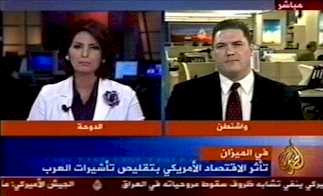 Al
Jazeera: What is the direct and indirect
economic impact of US visa obstacles in the Arab world? Al
Jazeera: What is the direct and indirect
economic impact of US visa obstacles in the Arab world?
IRmep: In this first detailed study we have estimated approximately
$101 billion dollars in losses to manufacturing industries in the US.
Losses for travel and tourism are approximately $1.8 billion. Higher
education, which is not usually considered a service export, has had losses
of around $2 billion which is equivalent to 9,000 jobs. This is problematic
because the Arab market is extremely attractive to the United States. It has
grown in terms of import demand from approximately $170 billion at the
beginning of this century, or rather, the year 2000, to over $345 billion
dollars estimated for this year. So as the US "locks out" industrial and
commercial buyers, along with the students and tourists, the losses are
mounting.
Al Jazeera: What, if anything are American businesses and government
officials doing about this situation?
IRmep: I think there is greater awareness and motivation to do
something now that there is a benchmark opportunity cost, which creates
pressure on the Department of Homeland Security along with the State
Department to invest more resources in visa processing. The global ratio is
one US consular officer for every 4,000 applicants. If the opportunity cost
of turning away, wrongly, industrial buyers, and officials don't necessarily
know who is a tourist and who is coming for big business, on average $1.4
million for some countries, then clearly the US has to invest more people
and resources in visa processes. People are beginning to understand that.
Al Jazeera: Is the US willing to make the
tradeoff between national security and letting more travelers from the
Middle East enter?
IRmep: There is no trade-off. Before 9/11 we were on our way to a
greater share of the region's commerce as well as academic interchange with
the entire 22 country Arab market. There is really no tradeoff with security
if we understand that the necessary security processes simply weren't in
place before 2001. By having adequate security processes as well as
understanding the huge opportunity costs for not processing visas securely
and in a timely fashion, we can identify the problem.
A lot of Americans are beginning to understand this from academia, to the
business world, and in government. |

 Sign
up for IRmep's periodic email bulletins!
Sign
up for IRmep's periodic email bulletins!