5/24/2004 MEASURE Poll:
The US Invasion of Iraq: One Year LaterPDF/Printable
The Middle East Academic Survey Research and
Exposition project polled 116 Middle East academics about the one year anniversary of the
US invasion of Iraq. The survey was fielded between May 11 and May 19, 2004. Drawn from a
pool of 2,300 academics with advanced degrees in Middle East area studies, IRmep compiled
and presents 116 survey responses. This poll should not be interpreted as a statistically
significant reflection on the views of all US Middle East academic specialists.
Question #1
Did the events of the last decade, American interests, and
terrorist attacks of 9/11 warrant a US military invasion of Iraq?
(Source: IRmep MEASURE 2004)

Question #2
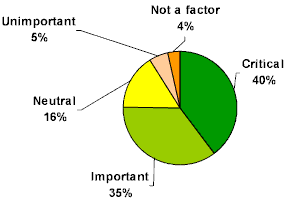
What drivers
do you believe are influencing Bush administration policies on Iraq?
(Source: IRmep MEASURE 2004)
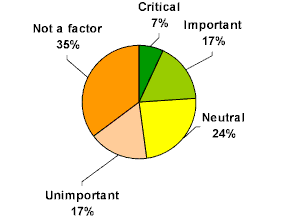
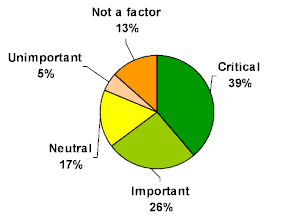
a. Establishing a military foothold in the Middle East.
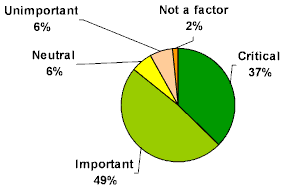
b. Control over petroleum
reserves/infrastructure.
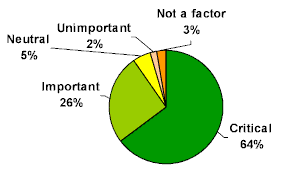
c. Concerns about the security of Israel.
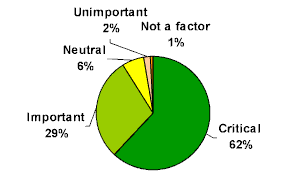
d. Transformational desire for Middle East democracy.
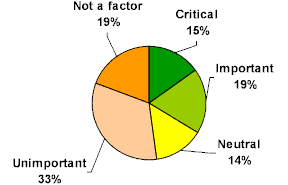
e. Private business interests.
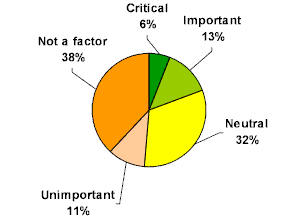
Question #2
What drivers do you believe should influence Bush administration policies on Iraq?
a. Establishing a military foothold in the
Middle East.
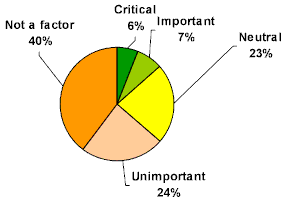
b. Control over petroleum reserves/infrastructure.
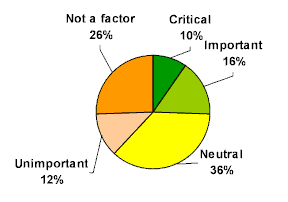
c. Concerns about the security of Israel.
d. Transformational desire for Middle East democracy
e. Private business interests.
Question #1
Comments
Did the events of the last decade, American interests, and terrorist attacks of 9/11
warrant a US military
invasion of Iraq?
- The invasion and occupation were and are illegal, largely
unilateral, have been incompetently and unjustly prosecuted, and they have increased the
threat of terror attacks on US/UK civilians.
- The US govt. pursues its "interests" in the Middle East in an ad hoc,
opportunistic way, and making war is not in the interest of either the American people or
the peoples of the Middle East.
- Question is pretty darn vague but I think I'd answer the same
way if you were more specific.
- 9/11 was not related to Iraq. "American
interests" as currently conceived are not a good foundation for US foreign policy.
- The combination of U.N. sanctions, weapons inspections and U.S. destruction of all
significant military/defensive targets in the no-fly zones had certainly neutralized the
regime as an active threat to any one, including the U.S. Any invasion motivated by the desire to liberate
the Iraqi people and their energies for the sake of their country should have been an
action of last resort by coherent multinational force acting under a U.N. mandate.
- Iraq was invaded under
false pretexts, which had nothing to do with the "war on terror" but much to do
with conventional geopolitical thinking and especially the fancies of neo-conservative
ideology.
- The invasion of Iraq was clearly considered and planned well before 11 Sept., and
executed for ideological reasons that seem fundamentally to have little to do with Iraq or even the Middle East.
- The invasion of Iraq is not justified on any grounds, strategic, political, or
moral.
- Iraq was paying a heavy
price due to misguided US policies. No substance to claims to support another attack on Iraq.
- Once decided however poor strategy wrecked much good
- Thanks to the first Gulf War and to the sanctions subsequently
imposed on Iraq, the country was scarcely a threat to anyone. The WMD have yet
to be unearthed and Iraq had nothing to do with 9/11.
- It warranted the Afghan war and the destruction of al-Qa'ida,
but certainly not the invasion of Iraq.
- There was no relationship between Iraq and September 11th,
despite the disturbingly common presumption that there was.
- At this point of history nothing can justify an invasion of
another country, colonialism, and human lose.
- I don't believe there was ever a clear connection between 9/11
and Iraq
established. Over the last decade the UN had
been dealing with Iraq inspections and while it wasn't perfect, I don't think it
required a unilateral invasion by the United States (and Britain).
- I believe that the neo-conservatives in the Pentagon wanted to
attack Iraq
whether or not the world trade center attack had occurred.
- I think an educated policy making would have prevented the birth
of so-called "terrorism."
- No clear, substantial beyond the reasonable doubt evidence of
weapons of mass destruction in Iraq.
- Saddam Hussein was a tyrant, but he was also the enemy of
fundamentalists, all of whom opposed his "irreligious" rule.
- No connection between 9/11 and Iraq; diversions of
attention and resources from al-Qaeda
- A catastrophically wrong idea.
- Its an established fact that there is NO connection whatsoever
between Al Quaeda and Iraq
- None of the stated objectives of the invasion has proven valid:
"weapons of mass destruction," inauguration of democracy, links to al-Qaeda,
etc. US
forces have apparently not even tried to arrest the group in Northern Iraq that
provided the "evidence" of Iraq's al-Qaeda links; the Turks did arrest some of them in late
April.
- Al-Qaeda was not based in Iraq. And even if there had been convincing evidence of WMD, this
war would not have constituted a "preemptive strike," because that implies that
Iraq was on the verge of attacking the U.S. - according to the definition of preemption -
which was not the case, whatever hostility Saddam had towards the American government or
people.
- We should have kept the pressure on Afghanistan, and made
additional pressure on Saudi Arabia.
- Absolutely not; the United Nations charter forbids military
invasion and occupation. The problems resulting from out illegal and immoral action were
all fully foreseeable.
- It was a pretext that served the predetermined plans of the
current administration
- The 9/11 attacks were not relevant to attacking a country whose
government was at an opposite pole from the attackers. It is shameful how ordinary,
uninformed people were made to think there was a connection. Saddam was a bad fellow, but
his worst crimes were while he was being backed by the U.S. Experience with Algeria, Vietnam, etc. should have
taught us that it is too late for such blatant colonialism. Also, respect the provisions
of the U.N. Charter on the use of force.
- The invasion was the worst foreign policy mistake made in the
history of the U.S.
- Iraq had nothing to do
with 9/11, and the "events" of the last decade include suppressive sanctions
that don't work.
- None of the above required, or even justified, military action
against Iraq. Events of the last decade proved inspections were
working; American interests have been damaged rather than edified; and 9/11 was related to
Iraq in that
U.S. policy
may have contributed to 9/11.
- It was a colossal mistake from the outset, both in terms of the
way it was carried out and its unilateral nature.
- The invasion did not serve American interests or stem the
growing terrorist threat.
- Anyone who studies the Middle East would have known that Hussein
and Bin Ladin are diametrically opposed and a liaison between them would have been a last
ditch effort to save themselves. The White
House should have known that.
- It should be clear to all by now that not only was the invasion
unwarranted, it has been disastrously counterproductive in every respect.
- Iraq had no part in 9/11.
- The Saddam Hussein regime SHOULD have been deposed by military
power in 1991. It had, however, nothing to do
with 9/11, & therefore the Iraq issue is COMPLETELY separate from 9/11.
- Iraq had no connection to
the terrorist attacks if 9/11
- Iraq is a diversion, or
rather an unnecessary, self-inflicted hurdle, in the "war on terror" which shows
how traditional weapons/thinking cannot solve the problem. Instead they make it worse.
- The invasion of Iraq has increased US vulnerability toward terrorist attacks and resulted in much
higher degree of anti-Americanism that US deserves.
- Not to condone 9/11, but it is the result of our foolish,
colonial minded foreign policy, esp. blind support of the Israel.
- These events and concerns warranted pragmatic diplomatic efforts
in the U.N., not a unilateral invasion.
- A solution to the Palestinian question would be the only
long-term stabilizer in the Middle East
- Which events exactly?
- Of course Bin Laden stated very clearly that the Bush
administration would invade Iraq and that the invasion would directly serve the interests and
appeal of al-Qa'ida.
- Since Saddam Hussein has obviously not been involved in the 9/11
attacks and is not involved with al-Qaida (he is actually opposed to them, due to his
secularist government), there was no reason to invade due to that. And where are these "WMD" that were
supposedly our reason to invade?
- The two are unrelated.
- No, because there is not a shed of evidence indicating Iraq was
implicated in 9/11
- I don't believe that 9/11 should be connected with Iraq. Rather, American interests are best served by the
removal, or demise of leaders like Saddam Hussein who are responsible for human rights
abuses on the scale that took place in Iraq. Attempts to fund
or aid insurgents were unsuccessful -- invasion was the only way to overturn the regime.
- It's clear the Bush administration has been lying again and
again about Iraq. We have abandoned
most of our traditional allies in an ill-advised exercise in military adventurism. The pre-2003 world that has served American
interests so well will not easily be put back together.
This seems almost a classic case of national hubris.
I'm guessing that historians of the future--at least American historians--will not
treat George Bush very kindly.
- It was important to reshuffle the Middle East and Iraq is a good place to
start. But the timing was bad; preparations on the military and especially the diplomatic
front were deficient.
- I do think there were justifiable reasons for invading Iraq, but these
are not them.
- The invasion of Iraq was unrelated to the 9/11 events.
The connection was completely constructed by the neo-conservatives in power by
manipulating the drama of the 9/11 terrorist attacks and the fear they caused.
Question #2
Comments:
What drivers
do you believe are influencing Bush administration policies on Iraq.
- The neocons do have a messianic vision of 'democracy' and it is
important for them, but their application of this desire is so selective - i.e. not in
Saudi Arabia, Occupied Palestine, DR Congo etc, that it cannot be considered a real causal
factor.
- I think the claim that they want to make the ME democratic by
invading Iraq
and imposing a new regime are a thinly veiled lie to justify seizing control of the
region. I think in making this claim, many
Americans believe them, but that the Bush administration seriously miscalculated the
complexities of Iraq. The notion that a
country can be invaded, occupied--with thousands on deaths on both sides--would result in
a democracy is clearly ridiculous. If they did
believe this then the administration is more incompetent than if this is simply a lie to
justify the invasion.
- Achieving a stable, economically viable state under Iraqi
leadership.
- All of this may be summed up in the neo-conservative ideology of
the administration.
- I would place "ideological view of the world and America's role
in shaping, guiding, and controlling global affairs in the interests of the US and its
allies/friends" very high on the list of drivers
- US already have a military foothold in the Middle East. It also has
ample access to, and control of oil supplies. Transformational desire for democracy is a
manipulative strategy to win public support. Invading Iraq first and foremost
serves the interests of Israel and US commercial interests.
- Combination of factors has promoted US policies toward Iraq, oil, Israel, opportunity to
punish Arab Muslims for 9/11, personal revenge, covered by the argument for democracy once
the argument for WMD failed to materialize. Hegemony of the Middle East that includes
Afghanistan
and its neighbors by the neocons seems a clear aim. These individuals wish to have the
attention of the American people elsewhere in order to carry out a broad agenda of their
policies at home. This seems clear from what
has transpired over the past three and a half years. What
seems also clear is that the selling of these policies has begun to be undone.
- Bush administration policies are influenced by others outside
but re-election dominates everything & public opinion must be satisfied.
- With regard to (c), it is less a matter of Israel's security (thanks
to the USA, Israel is a substantial
military power) but of getting Iraq to recognize Israel on the latter's terms.
- The democracy argument is not being backed up by tangible
actions, leading me to be skeptical of its importance.
- His influences completely ignore the needs, concerns and
aspirations of the Iraqi people.
- The U.S. already has a well-established military foothold in Saudia
Arabia, I do not believe the goal was to set up bases in Iraq for long-term
purposes. Certainly there would be more
interest in control over the petroleum reserves. Concerns
about the security of Israel play a constant and critical role in the U.S. foreign policy in
that region of the world. I don't think there
is a tremendous amount of concern for establishing democracy in the Middle East. That is rhetoric.
Certainly private business interest also plays a role in foreign policy
particularly when big oil/defense business is involved.
- There already are many military footholds in the Middle East - The US Navy
is very active in the Gulf.
- A desire to establish American type of democracy in Iraq has no validity. It
has no scientific base.
- The degree to which individual policy makers are influenced by
these drivers differs, but they all are important or critical to administration insiders
(including non-governmental advisors with direct access to policy makers). I also would point out that "democracy"
is not the focal point of transformation but rather marketization, which is why there was
so little concern for countervailing institutions (including state institutions) and the
focus on citizens' rights and liberties is fuzzy at best.
- Without 9/11, no war. 9/11
changed the president's mind on Iraq, and on the transformational policy advocated by neo-cons
- They already HAD a military foothold. Some people in the
administration may care about democracy in the Middle
East, but they haven't been pushing for invasion of
any place that doesn't have either petroleum reserves or strategic importance. People who
strongly support the current government of Israel (Wolfowitz, Perle) have considerable, perhaps determining, and
influence in the Department of Defense and have apparently made a strong case there for
the long-standing Israeli drive to destroy Iraqi military power -- even though Israeli
policy has failed conspicuously to establish security for the country or its citizens.
- Interestingly, we should not under-estimate the power of the
Wilsonian ideal ironically espoused by the neo-conservatives and at great cost to both
Americans and Iraqis.
- Now since there is enormous damage to repair our image (I can't
even say 'good will'):
- to stop fighting for two weeks
- to continue to apologize, and not talk about 'paying' them for
their torture
- to admit we were wrong
- to insist Israel remove the settlements (yes, it is all connected)
- The Zionist lobby and right-wing Christian romantics have driven
this invasion and occupation.
- concern about security of Israel and private business interests
- The talk about democracy was utterly hypocritical, designed to
placate those who otherwise would have opposed such actions. Washington depends too
much on alliances with authoritarian rulers whose continuation in power is critical for
the maintenance of its hegemony.
- You have clearly revealed your own ideological bias. THE reason
for the invasion, of course, is not even listed here: Saddam's destabilizing influence,
harboring and financing of terrorists, and threat to the whole region. Is your funding
Saudi, by any chance?
- Need to mention terrorism and historic legacy of 91 gulf war
- The President is a self-righteous lunatic. That's what drives
his "policy" in the Middle East.
- I see it as about re-shaping the international order of the
region in a way that is distinctly pro-US and pro-US business interests.
- Almost all are important.
- It should be noted that both Israel's security and the
prospects for democracy in the region have been very adversely affected by those policies
which this administration mistakenly believes will serve both.
- This is an administration bent on finishing off 'unfinished
business' of previous administration. Cheney was Sec. of Defense under Bush senior. He wants to finish the job started then.
- Our president is a born again Christian and he has messed up our
country. His definition of terror is arbitrary. Removal of Saddam was also influenced by
person vengeance for an attempt on his father.
- Stability in petroleum markets and appeasement of AIPAC are the
primary influences in my opinion.
- Basing rights, regional hegemony, and control of petroleum
resources are important now as they were important to Britain in the 1920s and
1930s in Iraq.
- The notion "all they understand is force" and that
smiting a Middle Eastern country, even the wrong country, will "send a message to
evildoers" is important too.
- Extending US global hegemony and capitalizing regions for US benefit are primary
reasons for its invasion of countries. Communism is over for the most part, so we're back
to the era of the British Empire and its "army of merchants."
- The US over the course of the last 20 years the US has increasingly
defined its interests in the Middle East in terms of Israel's. With respect to Iraq, the US is there to eliminate a strategic competitor to Israeli
regional dominance.
- Not clear what is meant by a "military foothold." We already have a military presence in the region. If you mean the ability to transport large
numbers of troops to hot spots quickly, then yes, we need to maintain that ability.
- I believe this administration naively and arrogantly thinks it
can remake the Middle East in some kind of American-Israeli image. A week and a half ago during a conference in Tehran in a private
discussion I heard a senior Iranian political-intellectual insider (a member of the
Ire's state security council--or whatever they call it) say that American policy in Iraq/the ME is
"insincere." In terms of stated
objectives in Iraq (the lies we all know about--Wads, links to Al Qaeda, etc.,
etc.), I agree.
- I am still confused about why the U.S. went to war in Iraq.
- The reserves are important, but all evidence points to complete
willingness on the part of Hussein and gulf leaders to provide oil.
Question #3
Comments:
What drivers
do you believe should influence Bush administration policies on Iraq?
- Stability
and peace require large doses of self-determination and democratic change in the Middle
East
at this point. Military footholds and control don't gel with this. Israel
can look after itself at the present time. Its obsessive security concerns destabilize the
region, they do not bring peace.
- The
Bush administration or its successor should remove the US
military from Iraq,
Kuwait,
and the other Gulf countries as quickly as possible. Creating true friendship with the
peoples of the Middle
East,
including Iraq,
should start with fulfillment of the two-state solution to the Israel/Palestine conflict
as laid out in UN resolutions. This means security for Israel within its pre-June 1967
borders, a real independent state for the Palestinians in all of the West Bank and Gaza
(with a secure connector between the two), internationalization of Jerusalem so that it
can serve as the shared capital of two states, and a just resolution of the Palestinian
refugee tragedy. The latter can be in the form of a negotiated combination of
"return" to inside Israel,
"return" to the new Palestine,
and compensation by means of donating the existing Jewish settlements to the refugees and
material help to resettle those refugees who choose to become citizens in their current
host countries.
- Democracy
should not be imposed by killing people off and setting up a US
military government. This is hardly democracy.
- Building
a just Israeli-Palestinian peace, as this is the most destabilizing problem in the Mid
East, the cause of terrorism and US
insecurity. I'd like to see the US
focus on building good diplomatic relationships, based on the interests of people in the
region, rather than opportunistic US
interests. The only real security comes from
good relationships.
- This
question does not address my ideas about what the Bush administration should or should not
be doing in Iraq. I think they should not have invaded. I think also that this invasion has made all of the
options above more difficult to carry out than if they had contained Saddam. The main problem was that Saddam refused to play
according to the rules, as they set them out---for instance the US
has no problem with establishing military bases in countries which have dictators or
violate human rights. They also could have
created a policy which enabled business deals...the only wrench in these possibilities was
Saddam's attitude towards the West.
- The
US
already has a major military foothold in the ME. There
are bases in Turkey...just
neighboring Iraq.
- HUMAN
RIGHTS should be at the top of any list of why and should.
- Genuine
commitment to justice, peace, democratic values, and global harmony should guide the
administration's policy towards not just Iraq
but the whole Middle
East.
The US
alliance with Sharon's
government in Israel
is detrimental to US interests around the world.
- For
an atmosphere where US
business will be welcomed in the Middle
East
a policy of mutual respect & mutual benefit has to be established. Pushing for Sharon's
policies as Bush has, control of oil through force, & and attempting to impose some
brand of democracy in one country and support dictatorship in others are not the factors
that can lead to that kind of atmosphere. I am certain a high school student would come to
the same conclusion.
- Because
the occupation of Iraq
is bound to fail, so is the US
ambition to control the nation's petroleum.
- This
is hard to answer since it isn't clear what the baseline is.
Basically the status quo prior to the war was just fine as far as US
interests were concerned, and the proper thing to have done was nothing.
- Since
I don't think we should be in Iraq
to begin with, justifying it with any rationale is difficult.
- The
Bush administration needs to figure out how to leave with an Iraqi government with true
sovereignty in place quickly, overseen in part by an international not an American
supervisory institution that includes many Arab and Muslim members.
- I
think it should be influenced towards establishing stability in the region (which looks
almost out of sight at this point). It should
help rebuild the petroleum infrastructure --not control it.
It should take into consideration security concerns for the greater region--not
just Israel. It should be guided by building capacity in the
region and building democratic processes.
- There
are many ways to deal with oil production and oil reserves.
US
corporations play a major role in the control of Gulf oil reserves with or without the
invasion of Iraq. As for a military foothold, towards what end?
- Israel
- via Sharon and, unfortunately, Barak, has dug its own grave in the Middle
East,
and it will have to lie in it all by itself. The
U.S.
gets nothing at all from this effort for Israel's
security
- None
of the above. relations with Iraq
should not be different then the other countries in the world community.
- It
is interesting that you have no "driver" focused on the Middle
East
itself. I think that the most important driver
for US
policy should be regional stability and the second the encouragement of civil rights and
liberties, greater political participation, and political and economic transparency within
a framework of law and regulation. The
stability and accessibility of this region, with its pivotal role in the global economy,
is of primary importance not only to US
security and prosperity but also to global security and prosperity.
- Should
not have gone in at all. Already have military
bases. Oil is important, but Saddam was not a
threat to it
- Now
it's too late, the damage is done. No military foothold is possible there in the long run.
- US
should abandon its militarism or face increased resistance everywhere in the world; Bush
is incapable of formulating any policy whatsoever
- The
US
should never have gotten involved in Iraq.
In the current situation, the only way to get out is to let Iraqis choose their own
government -- which may choose to negate all the other US
interests listed.
- However,
whatever the factors driving the policies, war should not be among the options - too late
now, of course.
- Trade
and cultural exchange are our only legitimate interests in the Middle
East.
- None
of the above
- The
"Transformational desire for Middle
East
democracy" would be good in principle, but promoting it through such invasion would
not be the way to do it--even if that were the goal.
- The
most important issue is establishing order in Iraq
so that the military can leave. They should
not have gone in but now that they are there they should finish the job: Establish a viable government -- it will inevitably
be anti-American -- and leave.
- Again,
the key reason, and the reasons on account of which the US Congress authorized the war,
are glaringly absent from your "survey."
- Choices
are regional, not Iraq
specific
- I
think that U.S.
policy in Iraq
now should be driven by a policy of cutting losses, not only in Iraq
but also with the rest of the international community.
The gaps are wide and the U.S.
is self-destructing.
- We
should take our rhetoric more seriously, and support the kind of reform US policy has been
talking about for fifteen years, though has consistently refused to implement (i.e. stop
bankrolling dictators, overlooking massive human rights abuses by allies, and turning a
blind eye on Israel's occupation of the Palestinian people).
Promoting a peaceful resolution of the Israeli-Palestininan conflict should be the
foremost issue on the US
agenda.
- The
Bush administration should be working to get US troops out of Iraq.
- The
US
needs, at long last, to realize that Israel's
long-term security in the region can only be assured through a just and durable peace with
its neighbors. Current policies which purport to serve Israeli interests merely extend and
deepen the conflict and makes peace ever more unachievable. The myth about the lack of 'a
partner' etc. must be abandoned before it actually becomes reality (an eventuality which Sharon's
govt. is only too keen to see).
- Support
for Israeli security need not to harm US
position with the Muslim world. Bush
administration has done the exact opposite.
- Pre-emptive
strike was wrong. Should get out as soon as possible and bring the UN. The whole thing has
brought disgrace to America
and suffering to Iraqis ... thousands of civilians are killed and enormous damage to the
country. It has hurt our economy too.
- America's
security and global image need to be placed above concern over the Jewish vote and/or
concerns about Israel
are having its way in the peace process. Current policy borders on lunacy.
- No
reason at this point should warrant an invasion of Iraq,
but it's a little late for that.
- The
most sensible US
policy, if possibly the most difficult, is that of honest broker between the states of the
region. That may no longer be an option given the invasion of Iraq
and the aftermath that we are witnessing. The best thing for the US
to do is to cut its losses now.
- None,
he should not be there.
- These
"drivers" do not justify warfare on our part. There are other ways of pursuing
our national interests. "Control over petroleum ..." is a bad question. We don't
need "control" to pursue our important interest. We need an international
marketplace.
- I
strongly believe that the Bush administration should not be so heavily involved in Iraq
at all.
- Concern
for the rights and human needs of the Iraqi population must be the goal of US policies in Iraq
if they are to conform to the Geneva
conventions. Those are the responsibilities of
an occupying army.
- I
believe this administration naively and arrogantly thinks it can remake the Middle
East
in some kind of American-Israeli image. A week
and a half ago during a conference in Tehran
in a private discussion I heard a senior Iranian political-intellectual insider (a member
of the IRI's state security council--or whatever they call it) say that American policy in
Iraq/the
ME is "insincere." In terms of
stated objectives in Iraq
(the lies we all know about--WMDs, links to Al Qaeda, etc., etc.), I agree.
- I
believe that the U.S.
should get out of the region and allow people to build robust, healthy, accountable
societies. That includes ending support for
neo-liberal policies that increase poverty, such as privatization, as well as support for
the huge military base called Israel. When hell freezes over, I guess.
Question #4
Comments:
If you could
give the current or a new incoming administration three recommendations for Iraq policy, what
would they be?
1.
Transfer
political and military power to a transitional UN body.
2.
Phase
out troops
3.
Implement
a Marshall Plan
---
1.
Get
UN involved
2.
Avoid
clash with Shiites
3.
Leave
it to John Kerry
---
1.
Get
the US
military out of Iraq
and the Gulf immediately.
2.
Provide
generous economic aid, without strings attached, for rebuilding the country.
3.
Stop
selling armaments and stop giving military aid to countries in the region, including Israel.
---
1.
Let
the Iraqis figure out what THEY want rather than telling them what they should think.
2.
Involve
the UN more.
3.
Reconstitute
the Iraqi military into a basic police-style security force to help with day to day
violence and stability issues. Do more
rebuilding.
---
1.
Internal
stability with justice
2.
External
stability in region
3.
Improved
US
understanding of cultural difference -- dump the clash of cultures approach
---
1.
Can't
do so, without knowing what will happen in late June.
2.
Withdraw
and let the UN deal with Iraq.
---
1.
End
the coalition's occupation of Iraq,
phasing it out over the next six months
2.
Let
the Iraqi people really choose their own leadership (not the corrupt Chalabi or others
handpicked by the US)
3.
Establish
an equal relationship with Iraq
---
1.
Internationalize
the occupation
2.
Hand
over sovereignty
3.
Get
out as soon as possible--a UN peace keeping force will do more good than a US
military occupation.
---
Anything
the US
does to influence or create a new government will be instantly discredited.
1.
Human
Rights
2.
Involvement,
as approved by Iraqis, of the International Community, including Arab States, esp. at a
community to community level; e.g. establish "sister" towns & villages.
3.
Iraqis
should be involved far more with the rebuilding of their own infrastructure, as there are
numerous well-trained engineers already there, etc.
---
As
soon as possible, place authority and administration in the hands of some combination of
indigenous Iraqi leaders and UN technicians, secured by a mixed international and national
army.
Remember
the commitment to reconstruction. Sustain the funding for this activity long enough to
solidify the material and social achievements.
Never
make such a stupid mistake again, and, if you do, at least make plans for the aftermath.
Learn to think unconventionally in an unconventional world. Establish clear links of
responsibility and answerability in all facets of administration. Encourage a vibrant and
free press; undertake steps to educate Americans about the rest of the world and
especially vital areas of interest like the Middle
East.
---
- Disengage
as quickly as possible.
- Give
up all ideas of teaching the world by force to uphold an American style of government.
- Move
on to an international process of resolving issues. Listen, don't talk all the time.
---
- Place
immediate emphasis on negotiation and accommodation with all significant parties,
including those such as Muqtada al-Sadr that are not seen as advancing American or broad
Iraqi interests.
- Remove
the ideologues from policy-making positions and listen to the true regional and Iraqi
experts, both within and outside the government.
- Be
much more aggressive and timely in handing over responsibility for political affairs (and,
as much as possible, security matters) to the UN or other multi-national arrangement. The credibility of America's
role in Iraq
is damaged beyond repair and continued American control over Iraqi institutions can only
be counter-productive.
---
- Give
the UN a primary role in insuring a transition of sovereignty to real representatives of
the Iraqi people.
- Dissociate
the US
from alliances with corrupt politicians like Ahmed Chalabi and his supporters inside and
outside of Iraq.
Admit the failure of the Iraq
policy and hold those responsible (especially in the Pentagon and the vice president's
office) accountable for their failures.
- Revamp
the US
foreign policy towards the Middle
East
and pursue an even-handed policy towards the region. Recognize that the situation in Iraq
is intricately tied to the situation in Palestine/Israel and take genuine and positive
steps to solve both situations justly.
---
- Involve
the UN before it is two late
- Turn
Full Control to Iraqis as soon as possible.
- Leave
Iraq
as soon as possible
---
- Admit
the mistakes.
- Call
for time table to pull out.
- Call
for international support for security, reconstruction, & mending fences with the
Iraqi people & let them elect their form of government. Ibrahimi's proposals will
cause serious problems. What did he accomplish in Afghanistan?
The Loyal Jorge system has been in place for several thousand years, & the war
lords-war criminals are brought back to control, extreme poverty prevails along with
handful of individuals who through fraud, bribery, & drug trade have become the
dominant force in the Afghan society. If there is a lesson for Iraq,
it is not to repeat the same as in Afghanistan.
---
1.
Not
only bring the UN in but cede all authority to it
2.
Fire
Rusted and Chalabi
3.
Recognize
the authority of Ayatollah Sistani
---
1.
Remove
army activities from cities
2.
Turn
over all affairs to Iraqi political leaders
3.
If
chaos results divide the country into 3 parts
---
1.
Try
to transfer control to the UN.
2.
Failing
that, try to transfer control to an Arab coalition.
3.
Failing
that, leave!
---
1.
Withdraw
2.
Withdraw
3.
withdraw
---
Turn
the whole thing over to the UN as soon as possible, even if it means eating a lot of crow. If the Bush administration continues, fire everyone
remotely connected with the enterprise (this should be done before the election)
Really
internationalize the occupation; publicly roll of few heads for the serious bungles to
date; back away from Sharon and the Likud in Israel
as that issue is killing us in the ME.
1.
Send
in more troops
2.
Find
better ways to negotiate with local groups
3.
Don't
let isolated groups of soldiers run amuck and don't use negatively symbolic sites for US
operations, i.e. Abu Ghraib.
---
Historical
experience shows that when Arabs and Muslims are actually helped by American policies,
they appreciate America
and Americans; therefore American policy must seriously address the desires of the Iraqi
people, not Wolfowitz's or anyone else's grand plans for the Middle
East. If America
must have bases in the ME, let them be in Israel,
Jordan,
or someplace like Chad,
not in Iraq. It is very important to look at the larger Arab and
Muslim worlds, and thus to openly work for a truly just solution in Palestine/Israel, even
if that costs Israel control of land and resources, and costs America money, in devising
post-war plans for Iraq: just solutions must be sought in both countries concurrently. For the time being, without compromising his
authority in any way, the Americans must ensure the security of important, patient,
moderate clerics and tribal leaders, such as al-Sistani; nothing could imperil the
impending transition more than further successful assassinations of such voices of
moderation.
---
1.
A
fast rebuild of the infrastructure.
2.
Organize
free and democratic elections.
3.
A
prompt exit.
---
Work
to bring in all parties in Iraq-
even ones that are "anti-American" Democracy
demands that all points of view be represented
1.
Work
more closely with the UN, Europe,
and neighboring countries in the region.
2.
Get
troops out as soon as possible and put a priority on rebuilding basic infracture like
clean water and electricity.
3.
Tune
down the rhetoric and start listening.
---
1.
Go
home
2.
Go
home
3.
Go
home
---
1.
Invasion
and occupation of Iraq
is contrary to long-term US
interests, because occupations are always highly unpopular.
2.
States
are minor players in relation to Terrorism. Therefore invading countries is not going to
help much in the war on terror. On the contrary, it tends to make things more difficult,
because it dramatically increases hatred of the US
government.
3.
We
should represent mainstream Israeli and Palestinian interests. This drives extremists on
both sides underground, and gains popular support for US policies in the Middle
East.
In recent years we have agressively supported right-wing Israeli agendas, and have
actively worked against all Palestinian groups, moderate or otherwise. This recipe has
failed for several decades now.
---
1.
The
first priority is to withdraw from Iraq
as soon as possible.
2.
The
second would be to adopt a more evenhanded and more rational policy towards the occupation
of Palestine.
---
1.
Apologize
for the actions taken by an unelected figurehead and his de facto illegitimate government
2.
Prosecute
war criminals from the preceding administration and set up a commission to determine
reparations due Iraq
3.
Get
out.
---
1.
Withdraw
militarily from the Middle
East
- US military presence has always been a provocation to extremist elements.
2.
Resolve
the Arab-Israeli conflict - by pressuring Israel
to withdraw from all Occupied
Territories,
remove settlements, and allow some form of return/recompense to Palestinians in the
Diaspora.
3.
Cease
and desist from blindly supporting Israeli concerns/agendas in the region
---
1.
Get
out of Iraq
2.
Pay
war reparations
3.
Encourage
UN General Assembly to provide interim stability
---
I
would advise the administration to go to the roots of the problems. This approach of Mr.
Bush made the world a more dangerous place especially for Americans.
Realism,
Humanism, Feasible measures.
---
1.
Get
the UN and EU involved.
2.
Allow
the south and north of Iraq
to be semi-independent.
3.
Make
deals with conservative and even religious leaders, allowing them to participate in the
running of Iraq.
---
To
engage in consultation with Iraqi groups and factions, and with US allies (including
regional allies), and UN officials that would give each segment both agency in determining
and responsibility for the mode and the outcome of US
disengagement from Iraq. Second, I would indemnify Iraqis for damages,
ensuring that funds go directly to persons who have lost family members, their own health,
and property as a direct result of the invasion and occupation, as well as to the state to
compensate for collective losses such as damages to infrastructure, the looting of museums
and libraries. Finally, I would recommend
strong support of democratization in Iraq,
going beyond concerns for open markets to include support of individuals and groups
committed to working for the expansion of civil liberties and political participation, and
guaranteeing the rule of law in Iraq.
---
- Do
not do unto others as others do unto you.
- No
blood for oil.
- Turn
over to UN and get out.
---
- Hand
over to the U.N.
- Involve
the Arab League
- Support
democracy
---
- Internationalize
the transition
- Given
up on democracy -- go for stable, representative govt.
- Tell
Kurds clearly they can't have de facto independence
---
- Internationalize
by handing over to U.N.
- Hold
elections ASAP
- Reduce
troop presence while allowing an international policing force to oversee interim security
---
- Work
with other international actors; give up trying to do it alone.
- Stand
up to Sharon
and force Israel
to vacate the territories.
- Find
a strategy for dealing with al-Qa'ida that is not military.
---
- Withdraw
all troops immediately
- Establish
a compensation/development scheme for Iraq
- Bring
in patronage from the so called coalition
---
Clean
up the US
image, not by public relations gimmicks, but by voiding the "lucrative
contracts" and giving Iraqis the resources to help each other and themselves. In the
long term, this will be less expensive in money, human lives, and diplomatic credit.
Join
the International Criminal Court.
---
- Ask,
beg, bribe, cajole, etc. NATO members and key UN members to share the burden.
- Award
these same countries reconstruction contracts, regardless of whether they supported the
war initially.
- Appoint
a panel of prominent Iraqis who have domestic legitimacy to meet with the CPA about how
the 30 June hand-over should take place.
---
- Get
out
- Fair
and free elections
- Fix
U.
S.
policy in Middle
East
---
- Don't
invade other countries
- Find
a way out immediately
- Dedicate
resources for genuine improvements in Iraqi infrastructure
---
- To
leave soonest.
- To
apologize effusively.
- To
provide reparations.
---
- Involve
the UN directly
- Get
out as fast as feasible
- Support
a truly representative govt. of Iraq
---
Get
out sooner rather than later. That will mean fewer body bags.
- Finish
the job and leave
- Accept
the fact that the new administration in Iraq
will be anti-American.
- Encourage
democratic processes so that the government can be held responsible for developments
there.
---
Get
the hell out and give the UN full support to return the country to some semblance of
stability; make sure that democratic elections are set up within the next six months --
even if the results are not what US neo-cons want to achieve for "the new American
century"; make sure that Wolfowitz, Perle, Pipes, Ajami, et al. are permanently
discredited as Middle East "experts" (which Wolfie and Perle have never even
claimed)
Be
tough with them and brook no violence; seal off the Syrian and Iranian borders if you are
not going to take those regimes out as well; read John Derbyshire.
---
- Give
up on picking Iraqi leaders
- Give
more responsibility to the UN
- Train
troops better for civilian tasks
- Devise
a workable exit strategy immediately
- Dump
Chalabi and his cronies
- Employ
Iraqis in the rebuilding process and dump the Halliburton's and their ilk.
---
Link
up with local moderates, including moderate Shi'ite clerics, let them establish a
functional government, and get the Hell out of Iraq.
- Promote
democracy in all countries, including Israel.
- Promote
human rights in all countries, including Israel,
Saudi
Arabia
and Iraq.
- Promote
self-determination for the Palestinians and the Kurds, and political and cultural rights
for minorities everywhere, including Kurds, Shiites, Jews, Christians and Bahais.
---
- Withdraw
from Iraq
- For
interim period, UN should take care of Iraq
- Ensure
that Iraq
would be ruled by a govt. of Iraqis' free choice
---
- Negotiate
with the U.N. members to provide peacekeepers and help in clean-up;
- Drastically
reduce the expense on military maintenance and presence, and put those resources toward
rebuilding infrastructure;
- Not
to fear a democratically elected government, even if it is not fully compliant with U.S.
directions.
---
Get
out now.
---
- Create
a three state solution, either within a federal political structure or outside it.
- Dump
Ahmed Chalabi
- Genuinely
work with the local communities, even knowing that what they will want may not be what the
US
wants.
---
Work by diplomatic means to involve other countries in restoring security to Iraq
and remove US troops as quickly as possible.
- Settle
the Israeli-Palestinian problem on the basis of justice and international law, thereby
creating a truly viable Palestinian state, without checkpoints, and with Israelis in
control of their own water resources, air, and coast.
- Give
the Iraqis more power to deal with their own country.
- Strong
international presence with a distinct timetable for departure, based on goals agreed upon
with the Iraqis to be achieved before final pull-out.
---
Get
the military out. Give rebuilding and enterprise loans to Iraqi firms, schools, etc. Solve
the Israeli-Palestinian dispute on an equitable basis.
Current
administration: Make what gestures can still be made on the management if prisons -
immediately dismiss Rumsfeld and remove all private 'security contractors' from Iraq;
cease preparations for US indirect rule after June 30 and announce that the new Iraqi
administration will enjoy complete sovereignty; announce a timetable for complete and
final withdrawal of all US forces, including all bases, within one year from June 30.
New
administration: publicly distance US from previous administration's Iraq and Middle East
policies; abandon plans for indirect rule of Iraq from new US embassy there and confirm
complete sovereignty of new Iraqi govt., including freedom to establish whatever
constitutional form of state may be chosen by Iraqi people (since any attempt by US to
impose 'liberal' prescriptions will backfire at once on Iraqi democrats and progressives);
announce timetable for complete evacuation of all troops and bases within a year of taking
office (to be replaced if possible by Arab and Muslim troops under UN command where Iraqi
govt. may request outside assistance).
---
- Handover
political admin to the UN
- Withdraw
US troops as soon as possible
- Make
generous funding for Iraqi reconstruction as reparations to regain Iraqi goodwill and
prevent another failed state.
---
- let
the Iraqis have free elections, regardless of what the outcome might be
- let
the Iraqis have complete control over the oil, regardless of what the outcome might be
- Offer
the Iraqis to help with training the new army, education, justice system, etc.
---
- Hand
over transition to 'peace' administration to the UN.
- Get
US troops out of the country - they have neither the training nor the skills for peace
building.
---
- Withdraw
in a timely but responsible fashion.
- Remove
all long-term US
interests (oil contracts, military bases).
- Provide
generous funding for infrastructure, education, and health care.
- Declare
a timetable for withdrawal of troops.
- Have
the UN declared a trustee over Iraq.
- Support
the establishment of a UN administered multinational force to preserve the peace in Iraq
until a national government is formed.
---
- Support
Israeli security and a Palestinian state in the occupied territories with pullback of all
settlements in those areas.
- Give
Iraq
a true and full sovereignty through a transitional government of elected Iraqis. Stop to be fooled by Chalabi and the Co.
- Pressure
the countries in the region to open up their systems, more transparency, accountability,
and restrictions on people's choices and freedom.
---
- Get
out, and bring the UNO
- Pay
compensation to the Iraqis
- Respect
the "other" don't be aggressive
---
- Either
immediately increase the number of troops in the theater or pull out altogether. Sticking
it out in this configuration to prove Rumsfeld's thesis is not only insanity, it is unfair
to American active military and reserve forces who are having to pay the price.
- Everything
outside of military maneuvers/strategy needs to be totally transparent, and Rumsfeld needs
to fall on his sword (i.e. resign) to demonstrate to the world how serious the American
people take this issue of prisoner abuse.
- Abide
by the Geneva Conventions across the board. The selective application of it regarding
others with simultaneous expectations for treatment under it for U.S.
soldiers/citizens is the height of hypocrisy, and has been very damaging to our
international image.
---
1.
Get
the military out
2.
Establish
business partnerships with Iraqis
3.
Establish
some educational exchange program
---
1.
Bring
in the UN and bow out ASAP
2.
Investigate
the prison scandal thoroughly and don't allow a few low-ranking soldiers to become
scapegoats;
3.
Continue
economic and social re-building of Iraq.
---
1.
Internationalize
the conflict or evacuate. History shows us that endless arguments based on
"credibility" and "not showing weakness" lead to error, folly, and
pointless tragedy.
2.
Only
Iraqis can form a democracy in Iraq.
3.
There
is no successful example of a Middle Eastern occupation, but one can at least be aware of
past errors.
---
Establish
an independent Iraqi government ASAP and get out of there; repair loss of faith in US
government from global Muslims; let Iraq fight it's own wars rather than fighting them for
Iraq, giving the Muslim community reason to hate the US and having their extremist groups
commit more acts of terrorism against the US
1.
Get
out of Iraq
now.
2.
Force
an Israeli withdrawal from the West
Bank
and Gaza.
3.
Work
to eliminate nuclear arms in the region.
---
1.
Bring
the troops home immediately.
2.
Stop
following Sharon's
recommendations.
3.
Treat
Iraqis with respect rather than arrogance.
---
1.
Get
out of Iraq
- period. Withdraw.
2.
Think
ahead before exercising military action - and other foreign policy initiatives.
3.
Cease
neo-imperialism
---
1.
Give
local authorities more power and resources.
2.
Give
central authority to an older, respected man and let him establish govt. unpatronized by
the American ambassador
3.
Only
act militarily if requested to do so by Iraqi authority.
---
1.
Apologize.
2.
Pull
out the military.
3.
Pour
in aid.
---
Marginalize
the Vulcans; Internationalization of the transition process; Iraqification of political
power.
Put
in place mechanisms for true democracy. Work as a neutral but active broker on the
Palestinian issue. Get a true coalition in to work closely with authentic Iraqi
representatives, rather than "going it alone".
Please
please read history and consult academic specialists and also Iraqis about Iraqi history
and culture.
Hand
over sovereignty and control ASAP
---
Only two:
- Reduce
the damage caused by the Abu Ghraib Scandal as rapidly as possible to whatever limited
degree is possible; change the subject to a focus on point number two.
- Internationalize
all aspects of Iraq's
occupation and reconstruction as rapidly as possible in order to begin reducing our burden
in blood and treasure.
---
- Establish
an international coalition, including some Muslim countries, to oversee preparations for
elections and assumption of sovereignty. The US
would at most play a minor role.
- Distance
ourselves from Israel
sufficiently so as to play the role of an honest broker
- Provide
massive amounts of economic aid to Iraq
to compensate for the destruction caused by military invasion and occupation.
---
- Iraq
cannot become stable until the occupation has ended.
- All
those accused of criminal offenses against Iraqis in both the previous administration and
the occupation administration should be tried by an international tribunal; nothing less
would restore international confidence in the good intentions of the US.
- The
coalition must pay reparations for the destruction of the infrastructure and livelihood of
the Iraqis. These reparations will be
essential in creating the infrastructure necessary for stability after more than a decade
of sanctions and two US-led wars.
---
- Continue
dealing with insurgents, but simultaneously transfer key decision-making and political
functions to Iraqis.
- Engage
in a greater amount of dialogue with Iraqis, and the Arab press and Arab world. One appearance by our President post - torture
photos is not enough. Teach the troops that
names like "Hajji" are racist.
- Try
to institute structures that will not rest on sectarianism.
---
- Withdraw
forces
- Increase
UN involvement
- Provide
more economic aid
---
- Involve
the U.N. and NATO--especially in decision-making.
- Don't
presume to tell the Arab (and Muslim) world about how to govern them
- Develop
a rational U.S.
foreign policy vis-�-vis Israel,
an aggressive small state (but with nuclear weapons) bent on imposing its neocolonialist
will on a subject Palestinian population.
---
- Establish
international diplomacy to work with Iraqis to create a government of Iraqis, not American
puppets;
- Pull
out troops;
- Work
on rebuilding the destroyed infrastructure.
---
- Leave
Iraq
- Stop
using techniques used by the Israelis in Palestinian areas to attempt to control Iraq
- Stop
determining policy based on Israel's
recommendations
---
1.
Involve the UN
2.
Begin immediate negotiations with all Iraqi groups, including those that are hostile
3.
Change completely our policy towards Israel
---
Get
as much international involvement as possible; demonstrate humility; hand-over as much
authority as possible faster.
---
There
will never be a perfect time to get out of Iraq
now, so just try to do it as quickly and responsibly as possible. You cannot decide what the future of internal Iraqi
politics will be, and trying to control this will make things worse. Do not repeat arguments and justifications that you
know are false or unconvincing; we will not be universally adored for telling the truth,
but we will never be respected so long as we prevaricate on what our domestic and
international interests are.
1.
Support
democratic and feminist movements in the region.
2.
End
military support for Israel.
(This is unlikely given the strong links with U.S.
military-capitalist interests.)
3.
Learn
more Arabic, for God's sake.
---
1.
Get
the UN in.
2.
Pull
out US troops
3.
Allow
Iraqis to decide their future
Question #5
Comments:
A century
from now, what will be considered the key lessons from the US
preventive/preemptive war on Iraq?
---
- When occupying a country which you seek to control, don't
destroy the local power structure (chiefly the army, and the Ba'th Party). [Cf "The
Prince" Machiavelli]
- Don't underestimate the power of nationalism and the need for
hegemonic (as opposed to coercive) rule.
- Don't assume that one country owns the "sole model for
national success".
---
As the key event giving rise to the
new wave of terrorism and Islamic fundamentalism that caused trouble for middle ease and
the world for a decade.
A century ago, the British created
"protectorates" around the Persian Gulf, intervened in Iran at will, and plotted
with the French to create colonies (the so-called "mandates") out of the Arab
parts of a dismembered Ottoman Empire (what became Palestine, Jordan, and Iraq for the
British, and Syria/Lebanon for the French). The results of this policy have been nothing
but turmoil for the region for the last hundred years, and the feedback effects on Britain have been
negative -- they are much despised for their nefarious role in "transforming"
the Middle East to their own liking. The United
States is currently in the process of repeating Britain's misdoings in
the Middle East, and I expect the verdict (especially by the people of the Middle East) in one
hundred years will be the same: imperialism and colonialism do not serve the interests of
the occupied and colonized, or, in the long run, even of the colonizers. They create the
basis for more war and conflict, not for solutions to the problems of the region. The
feedback effects on the US are already negative: vague threats of more terrorism, the loss
of civil liberties at home, and a renewal of "the ugly American" syndrome in the
world at large.
---
Depends on how the above issues are
handled.
- How empires fall through overextension.
- How human rights are crucial but largely ignored or
misunderstood in a context of other national or commercial interests.
- How dangerous it is to have minority interests control the US
government
---
Legacy of British and French
imperialism in pre-WWI era--destructive after-effects; linkage between Reagan, Bush (41)
and Bush (43) administrations and business interests; futility of such actions.
I hope a century from now we will
have learned that military intervention is a problem, not a solution; that US military
interventions make our relationships considerably worse in the region concerned, hence
creating a more dangerous situation for the US, not a more secure one.
---
Preemption is naked aggression
You cannot prevent a war by making a
war
Military invasion and occupation are
ineffective strategies, enflaming nationalism, other forms of political unity (such as
through religion, ethnicity) to fight the invaders. If
your interest is in galvanizing the enemy/opposition invasion and occupation accomplish
this very well. These are not strategies which
will result in peace, democracy or even a free market, unless the US wants to kill millions
of people and seize control of all assets. Unless
the US wants
to become a lawless, aggressive regime (very similar to Saddam's Iraq) then these policies
are not an option.
---
Violence Begets Violence, as a
historical understanding of the regional events shows... In the 1950s, a CIA-lead coupe
overthrew the democratically elected president of Shia Iran in order to replace
him with the deposed Shah -- who was willing to sell oil to the US at less than the
market rate. This extremely oppressive and
decadent reign was eventually overthrown by violent fundamentalists, whose influence
reaches far beyond their physical and religious borders. The US $-backed Hussein's regime
for years during the first Iran-Iraq Gulf War, while turning a blind eye to gross human
rights abuses, esp. of the Kurds and Shia within Iraq.
After the 1990 Gulf War, the Iraqi Shia responded to the first President
Bush's call for internal revolt. They were
then slaughtered from the air, while the US military literally stood by.
And now this current horror of the US becoming very much an oppressive occupier of Iraq, esp. in southern
Shia region: If one's father or sister was tortured in prison at US hands, such as by
being sexually humiliated, it's not surprising that the Shia would feel duty-bound to rise
up against the US. All of which is
being exploited by terrorists.
---
At a minimum, it will be seen as an
ill-considered, faith-based, ideological exercise in naive imperialism. Beyond that, the
magnitude of the consequences, all negative, will depend upon this administration's
ability to admit that it falsified the rationale for this undertaking and based it on the
views of persons who were totally untutored in the history and culture of the region. It
will surely result in a loss of respect for central American values both abroad and at
home.
---
I believe history will not consign
George W. Bush to its garbage bin but damn him to hell. Einstein commented after 1945 that
in a world that could divide the atom peace must now become indivisible. This
administration has blindly pursued an ill-informed neo-conservative ideology and agenda,
which had become obsolete before it even took office. After 9/11 it was imperative to
learn quickly how the global world had changed, but the Bush administration was incapable
and unwilling of undertaking such new learning and rethinking. The "war of
terror" could only be meaningful and profitable as a war of foxes and not elephants,
and the Bush-Cheney Administration manipulated an atmosphere of fear--as opposed to
rational dangers and probable risks--to carry out an agenda it had already set for itself
and crashed in like elephants. It has harmed the long term interests of the United States so
gravely that it will take decades to appraise the extent of the damage. It has made a
mockery of international law and, therefore, made it unlikely that any nation state will
feel moral compelled to adhere to international standards when they go against its
interests. At a time when we urgently needed courageous moral and politically sound
leadership, George W. Bush gave us the opposite. History will not forgive him.
---
It is not possible for one regime (US) to force its format
on another nation, not just in the Middle East, but anywhere.
---
1. Don't let ideological fervor blind
you to practical considerations (that should have been learned already from Vietnam).
2. Military victory, even when quick
and relatively painless, is not the answer to regime change.
At best, it is the instrument that permits the introduction of more
fundamental and complex political and administrative transformation (that should have been
learned already from British experience in Iraq in the first half of the 20th century).
3. Despite America's overwhelming
power in the early 21st century, it could not ignore the rest of the world and rely solely
on brute force to solve a difficult problem.
---
The conduct of foreign policy is too
important to be left in the hands of ideologues willing to engage in lies and deception to
achieve ill-conceived goals.
Military solutions to international
problems have limitations.
Alienation and defiance of world
public opinion is destructive and can lead to disastrous consequences.
Long-term consequences of policies
must be studied and evaluated before actions are taken.
Global leadership can not be achieved
by coercion.
---
This war has no real base, and it
dose not serve the interest of the US
---
The US is a great country
which clearly is capable of doing much good for its citizens and for the world if only the
rules of mutual respect, free markets, and sharing in the resources of the world and
discoveries of technologies are carried out for multilateral benefits and through
multilateral agreements. The Iraq war will be an example of bad policies and use of raw power
without regard to consequences.
---
No pre-emptive war. Use of diplomacy
instead of guns. Disasters result from ideologue administrations
---
- Regular armies do not fight in hostile cities
- Globalization will stop the blood letting
- The UN must handle affairs in Iraq
---
Another failed imperial project
which, combined with the United States' virtually unqualified support for Israeli expansionism, sorely
compromised the American position in the Middle
East.
---
It was doomed from the beginning
---
The fact that the US has the ability to
quickly and decisively defeat the *military* of Iraq was almost entirely irrelevant for the vastly more complex
task of controlling Iraq politically. In a
century, we may also look at this as one of the last times that the US undertook an
effectively unilateral military action without the backing of most other major powers
---
That a hyper power unchecked and
unrivaled engaged in a hubristic attempt to remake the world any way it wanted, and
instead discovered the real limits to even overwhelming military power.
---
Don't invade a Middle Easter n
country without the support of the Arab/Muslim world & the UN
---
One cannot accurately predict what
the lessons of history will be after many later events have changed peoples' view of this
past, but in the shorter term, there seems to be little doubt that this war will be
remembered by scholars, journalists, and well-informed individuals as one that fuelled by
misinformation in the planning and justifying stages, and was riddled with utterly
unnecessary mistakes due solely to the insolence and ignorance of key officials who were
fully warned of probable dangers ahead of time by knowledgeable sources--dangers spanning
from the probability of disastrous looting immediately following the war to the importance
of having enough troops on the ground, and the unlikelihood that leaders from exile such
as Ahmad Chalabi would find much Iraqi support. Several
main lessons might or might not be learned from this war, not all of which have to do with
the preemptive nature of the war, among them, the importance of strong, realistic post-war
planning--at which this administration has failed miserably, unfortunately--and the
lasting problem of failing to garner international support, especially when no ethnic
cleansing or genocidal measures are involved. No
intelligent, informed American believes that weapons of mass destruction had much to do
with the genesis of this war; the larger international community never did believe that
Iraqi WMD were a real threat, and the moderating role of that larger community was ignored
in the prosecution of this war. One hopes that
realization that the moderating role of international consensus is crucial to decisions
about wars of any kind--except when genocidal conflicts are to be quelled--is what will
emerge most prominently from this experience.
---
There was a grave misunderstanding of
the culture and beliefs of the Iraqi people, and diplomacy is always the better option.
---
Know the facts before you intervene!
---
Pre-emptive War is an extremely
dangerous policy.
Colonialism ended in the 20th century
- and attempts in the 21st Century brought predictable results: failure and animosity.
The United States policy of
separation of Church and State was a brilliant foundation of the country that was sadly
eroded under the Bush administration.
---
Go home
Go home
Go home
---
By then, international law will be
more important in politics, so the fact that we invaded Iraq illegally will be
remembered. It will also be remembered as a desperate, misguided and failed attempt to
fight terrorism. By then, I suspect that they will have more effective strategies for
dealing with terrorism.
---
This will be considered a mistake on
par with the US invasion of Vietnam and the USSR's invasion of Afghanistan
---
When the President thinks Jesus is
authorizing his actions, Congress should initiate impeachment hearings, not war.
---
That the US's preemptive actions
have lent further vindication to Islamism, which in itself is a product of the globalizing
policies the US has pursued. As a
result of the chaos we have caused in the region, we have doomed it to economic
underdevelopment and eventual irrelevance as its resources will have been replaced by
those in Central Asia even before they are exhausted, and they most certainly will
have been in a century's time.
---
The U.S. imperial expansion
destabilized much of the world.
---
A historical event cannot be
evaluated at the time and space which occurs. Its ramifications unfold as the time passes.
The images pertaining the war and the prisons will not disappear from the collective
memory of the Arabs and Islamic world. The US needs to pay high prices to win the trust of the third world
countries in general and Arabs and Muslims in particular.
---
Proliferation of weapons of mass
destruction.
---
This will be seen as the "lesson
not learned from Vietnam". Military force is essential in many instances, but it
only works in the shortest term. Cultural conservatives and others who think the US has nothing to learn
from other cultures rely solely on military solutions -- which have only a limited
usefulness.
---
That unchecked power threatens
everyone, including the citizens of the unchecked power; That international institutions
which reinforce the global power distribution rather than Diluting its effects is
worthless; that individuals can stand up to power and be effective in checking it, just as
their refusal to stand up to power strengthens it. Learning
these or any other lessons is contingent on a resolution of the current crisis that does
not include damaging the current political economy beyond repair. A global economic collapse and/or another world
war, both of which have been made more likely by current US policy, generates too many
unknowns (known and otherwise) to imagine how US policy today will look one hundred years
from now.
---
That we cannot impose democracy on
any entity.
---
1. It doesn't work for a country that
is considered an empire.
2. Even the most powerful country,
needs help from the 'little guys' on the ground.
3. Ideology gets in the way of
objectivity
---
Don't get involved in remaking
societies that you don't know much about, and, if you do, be willing to commit the
resources up front, right away, to establish security.
---
1. Disregard for international norms
governing use of force leads to precipitous loss of legitimacy
2. Combating terrorism requires more
of a policing approach than a primarily military one
3. Iraq will figure as a key
moment in the rejuvenation and reinforcing of al-Qa'ida and Islamism, generally, in the Middle East
---
Failure of preemptive war as a
strategy. End of the discussion over whether the US is an "empire" or not. (It isn't, and now it's going
to lose ground rapidly.)
---
Shameful, useless waste of human
resources; international terrorism, and another step in implementation of a detrimental,
terminally flawed policy
---
Occupation of Muslim lands by
foreign/Christian countries is very costly.
---
Waging a war on untenable premises
and for unacknowledged reasons can lead to unintended consequences.
Democracy isn't authentic if an
external authority sets limits to the acceptable outcomes.
An attempt to establish
unchallengeable military and economic power worldwide is likely to arouse strong
opposition.
---
(1)
Preemption was not at issue, and the U.S. preventive war is actually no different from aggression
according to well-established international law.
(2) A war of ideas must be replaced
by diplomacy and dialogue - not winning the hearts and minds, but rather earning the trust
and respect of the Arabs and others
(3) Democratization cannot be imposed
out of the barrel of a gun.
(4) U.S. troops should not be
sacrificed for missions that are not core national interests.
---
Big Mistake. Pro-Israeli interest misled the U. S.
---
I think it may well be seen as the
first and last act of the expansionist empire of the "new American century"
---
1) Mixing of evangelical righteousness and bombs doesn't work;
2) That America no longer walks the moral high ground, and those generations
will still be paying for this disgrace;
3) Business interests and Christian righteousness leads to bombing
others.
---
Illegal and immoral military
adventures that disregard loss on innocent lives will arouse nationalism and provoke
international condemnation.
---
how not to get involved in wars not
serving directly American interests and let not countries with strong influence on
American policies dictate them to the detriment of U.S. interests
---
Don't let this country's policy be
manipulated by a few ideologues who are hiding their loyalty to a foreign state behind a
pretense of extreme American patriotism.
---
1) A pre-emptive war is desirable only when there is clear
reasonable cause.
2) It should be undertaken only when the wider community of nations
agrees that it is necessary.
3) Wars should be addressed to real enemies: in this case it should have been against Al Qaeda,
which the Bush administration must have known was not involved in Iraq.
---
It was an asinine and
"un-American" step
---
Too early to tell. Up until now, that
the US
wasn't willing to fight to win and underestimated the Arab reverence for overwhelming
power and force.
The real question is whether or not
Arab/Muslim society is able and willing to be free and civilized or not.
---
wars of choice are dangerous and have
unintended consequences for the initiator. Can't
impose democracy through military force. US govt. does not have
adequate civilian resources for post-conflict situations.
---
- You can't "democratize" a country by force.
- The Iraq war will be seen to have marked the beginning of a precipitous
decline in United States stature and influence in world affairs.
- The Iraq war will be seen as a period which resulted in severely
curtailed rights and liberties for American citizens and perhaps the beginning of the end
for whatever remains of democracy in the United
States.
---
Never elect a Texan as President.
Don't forget LBJ and Vietnam; don't forget Bush and Afghanistan/Iraq.
---
- The dangers of allowing ideologues/fundamentalists decide on
foreign policy.
- The damage to U.S. principals caused by arrogance, unilateralism, racism and
hypocrisy.
- The terrible cost in human lives and material wealth in the Middle East and the United States, and the
resulting damage to those societies
---
There is no preventive/preemptive war
on Iraq. Iraq under Saddam is
never a threat to US. The question is irrelevant.
---
- More evidence of needed before war is waged;
- The branches of government have a role, not just the Executive
Branch;
- Oil is not worth it.
---
Arrogance does not pay.
---
Look before you leap, i.e. think
about what comes after you win the war, and focus more on winning the peace.
---
Preventive wars rarely work, and
certainly do not work if the "facts" driving them cannot be proven true to other
countries or to the American people.
---
That it is indeed a very bad policy
that only leads to strife between the nations of the world.
---
American hubris in Iraq will have spawned a
new generation of militants drawing on both radical Islam and nationalism. Until we show
respect for the dignity of other nations, we will be mistrusted, and often hated.
---
That calls for 'preemption' of
supposed threats whose reality is not immediately demonstrable (cf Cuba and Iraqi 'WMD')
should be regarded with great suspicion, as (as in this case) more likely to be covers for
other agenda which have no basis in the 'threat' presented to the public; that a genuine
commitment to multilateral diplomacy is indispensable and that the US can no longer act as
sole superpower against international legality and consensus without irreversibly damaging
its own interests and, ultimately, security; that the 'clash of civilizations' was a
hugely irresponsible self-fulfilling prophecy; that democracy cannot be delivered on the
tip of laser-guided munitions (dixit Chris Patten).
---
The need to work cooperatively with
the international system and within recognized bounds of legality.
That the war on terror was much set
back by invading Iraq.
---
- Don't invade a country unless you have both a plan & the
forces to maintain the peace afterwards
- Don't let ideologues tell you what a foreign country is like
-> ask the academic specialists
---
Might alone cannot change the outlook
of a state or a people
---
The lunacy of rushing to war under
false pretenses.
The self-fulfilling prophecy of the
"war on terror."
---
Ensure that no conspiratorial,
ideologically- driven, group can hijack the foreign policy of the US again & involve
the nation in overseas adventures.
---
Empires have a tendency to get ahead
of themselves and lay the ground for their own downfall!
---
It will be considered as arrogance of
power, colonial mentality to subdue other nations/people and to control other countries
and exploit their resources to keep up the American living standards and total disregard
for other people or moral/ethical values
---
1) That preemptive war is never a better option than diplomacy.
2) That blind acceptance of any administration's military/security
policies by the public is dangerous to our national security, economy, and global image.
3) That the Bush administration and its unilateralist,
neoconservative policies represents the apex of American hubris in the post-Cold War era.
---
A foolhardy policy that resulted in
the exact opposite results of those sought out.
---
It will be seen as a disastrous
undermining of US image and values in the world.
---
The question is poorly worded since
both "preemption" and "prevention" posit an actual threat.
Lies and incompetence mixed with
self-serving arrogance lead to tragedy. The ultimate scope of the tragedy is unknowable at
this point.
---
If you have a reason for
attacking/invading another country, your reason better be concrete and provable to the
world community for justification. Remember,
it's not what you "know," it's what you can prove.
---
That depends on who wins. My guess is
that the US "loses" almost no matter what happens given the
hopeless contradictions in its position. An interesting question is whether or not Israel is successful in
becoming unchallenged regional hegemon, and Iraq is only one issue among several that will affect that
outcome.
---
Do not engage in pre-emptive military
actions.
---
Shame
---
1. Elect intelligent leaders.
2. Avoid excessive use of power
(military, political, economic.)
3. Human rights are more important
than hegemony.
---
Many of the same things said about
the Spanish American war. We will "win" but at the cost of much respect. It may
be the beginning of a decline in our world power. Our government will be considered very
hypocritical in what they say about the (unjustified) use of violence. It may be the
beginning of an ever growing distance between of proclaimed democratic principles and our
global domination.
---
Terrorism cannot be broadly solved
through 'war'/military action; the danger of U.S. foreign policy driven by a convergence
of extremist Christianity and Judaism against extremist Islam; the naivet� in the 21st
Century of electing a U.S. president not experienced and/or well-versed in international
law and diplomatic relations.
---
Preemptive war is ineffective and
unreliable. Authentic global participation in any military or humanitarian acts. Policy
needs to be driven by ethics rather than self-serving pragmatism.
---
The tragedy of going in so
ill-informed and unprepared.
---
Do not pre-empt; do not go it alone;
respect international law; know what you are beginning; be honest about your real reasons
to the public
---
Imperial over-reach or over-stretch:
How the US actually hastened its decline as a global "Superpower" because of a
quixotically ill conceived, grossly miscalculated foreign war and occupation.
---
The counter productivity of
unilateralism in foreign policy. The major
players must learn to work together
---
Preemption is inconsistent with the
international system established after World War II.
Occupation involves responsibilities
for the occupied population that must be included in the planning for war.
Toppling a foreign government does
not necessarily lead in the long term to the gratitude of the subject population.
Occupation and its effects are not
universal; a successful occupation of Germany would not necessarily work in a country with a different
historical experience of national construction and occupation.
---
Iraqi regular military was
over-rated, but its "insurgent ability" was underestimated.
I wonder if it will be remembered
that war was declared to eliminate WMDs, or history rewritten to trace the removal of a
cruel dictator.
---
Don't get involved in something you
don't understand
---
1. Policymakers ignored history, particularly the 20th-centry
British experience in Iraq.
2. Military power does not translate into world hegemony
3. Admiration abroad for American ideals is worth a great deal more
than seeking to impose some perverted version of those ideals by military force
---
Don't let the Bushes steal the
election via a coup, then run roughshod over Iraq for a second and more deadly time.
---
I would like to say "Don't lie
to the US
public," but I suspect government will only find ways to lie successfully.
---
Moral authority is required before
one can launch a transformative operation such as the invasion of Iraq. When the U.S. has no moral authority with the persons sought to be liberated,
those persons will be hostile.
Military force is effective for
immediate tearing down, but an extremely blunt instrument for rebuilding.
---
the need to reform the intelligence
community; the mission isn't over with the end of major combat operations, thinking about
the day after should get higher priority; the significance in coordinating diplomatic and
military steps in a way that will give the president more available options instead of
chaining him to a small number and under considerable time constraints.
---
Intelligence is never as exact as we
would like. Good intentions do not mean that a
war will go well. And, no, we can't do these
sorts of things on our own.
---
It was another huge disaster, maybe
(hopefully) the beginning of the end for U.S. Empire.
---
That colonialism and empire are alive
and well.
About MEASURE
Measure is the acronym of Middle East
Academic Research and Exposition. MEASURE is a
grant funded research tool that advises policy makers and the American public on highly
relevant topics. MEASURE surveys are fielded
by the Washington DC based Institute for Research: Middle Eastern Policy, (IRmep) a
non-profit, non-partisan, non- ideological public policy institute.
MEASURE surveys academics via a series of multiple choice and open questions to compile
and aggregate of informed opinion on timely policy issues.
116 MEASURE survey candidates are drawn from a pool of 2,300 academics with advanced
degrees in Middle East area studies. Not all MEASURE candidates teach or write
about contemporary Middle East issues, but are generally more informed and involved in
regional issues than their counterparts in academia, and reside within Middle East university
departments. The terminal degree profile of
this pool reveals a majority at the PhD and Master level.
MEASURE
Pool Terminal Degree Profile
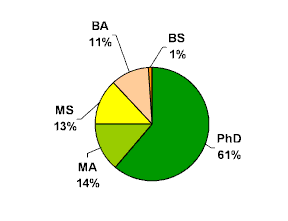
MEASURE survey results are presented in aggregate form
only. Individual responses are anonymous. MEASURE survey results are presented
to the public in a timely fashion and also made available to policy makers and the press. MEASURE avoids uninvited or multiple survey
responses by soliciting response by invitees only and discarding repeat responses. Download PDF |

 Sign
up for IRmep's periodic email bulletins!
Sign
up for IRmep's periodic email bulletins!